
October is AAC Awareness Month, a time to celebrate the many different ways people communicate!
Most of us think first about spoken words when we think about communication. But communication can happen in many ways: through speech, facial expressions, gestures, signs, pictures, written words, or technology.
For some children and adults, Augmentative and Alternative Communication (AAC) is an important part of how they communicate.
What is “AAC”?

AAC stands for Augmentative and Alternative Communication. It includes any form of communication that supplements or provides an alternative to speech.
AAC can be as simple as pointing to a picture or using a communication board. It can also include signs and gestures, or technology such as an iPad or dedicated communication device that speaks a message aloud.
Some people use AAC because they do not use spoken language. Others can speak, but their speech may not always be understood or may not meet all their communication needs. Some people use AAC only in certain situations, while others rely on it throughout their lives.
AAC does not replace communication. AAC is a tool used to support better communication, and for children who are developing language skills, a tool for learning vocabulary, language, and literacy skills.

Myth: “AAC will stop a child from learning to talk.”
FACT: AAC does not prevent speech development.
Parents sometimes worry that if a child can press a button or point to picture to say what they want, they will no longer be motivated to talk. Research does not support this concern. In fact, AAC can support language development and, for some children, may accompany increases in spoken communication.
A child does not need to “earn” access to AAC by first proving that speech will not work. Providing another way to communicate can reduce frustration and give a child more opportunities to participate, connect and learn language.
Myth: “A child needs to be ready for AAC.”
FACT: There are no prerequisite skills a child must master before being given access to communication.
A child does not need to understand cause-effect, match pictures, point accurately, or demonstrate a certain cognitive level before AAC can be considered.
We do not wait for typically developing babies to prove that they understand language before we speak to them. We surround them with language and help them gradually learn what it means.
AAC learners need that same opportunity.
It is also important to remember that a student who cannot easily tell us what they know may understand much more than they are able to express. Providing access to communication gives students more opportunities to show us their ideas, interests, personalities and abilities.
Myth: “If a child isn’t using their AAC tool, it isn’t working.”
FACT: Learning AAC takes time and lots of modeling.
Imagine being handed a device containing hundreds or even thousands of words and being expected to immediately know where everything is and how to combine those words into messages.
Children learning AAC need to see other people using AAC.
This is sometimes called modeling AAC or providing “aided language input”. Adults can touch words on the child’s communication system while they are talking, without requiring the child to copy them.
For example, while blowing bubbles, an adult might say, “More bubbles!” while touching “MORE” on the child’s AAC system. During a game, they might model “GO”, “STOP”, “MY TURN”, or “FUN”.
The goal is not to make the child press the same button. The goal is to show them, over and over, that their AAC system is a meaningful way to communicate.
Myth: “AAC is mainly for asking for things.”
FACT: Communication is about much more than requesting.
We communicate to joke, protest, ask questions, share ideas, tell stories, greet people, complain, connect with friends, express feelings and say things like:
“That’s funny!”
“I don’t like that.”
“Guess what happened!”
“Leave me alone.”
“I have an idea”
AAC learners deserve access to all those purposes too.
When communication is accessible, students have more opportunities to participate in classroom learning, build friendships, make choices, advocate for themselves and feel that they belong.
Can you spot AAC in your school?
During AAC Awareness Month, take a look around your school. You might notice communication or core boards, picture symbols or flip books, communication symbols on a lanyard, or a student using an iPad or another communication device.
You may also see adults pointing to words or pictures while they talk. They may simply be modeling language, showing the student how their communication system can be used.
Communication happens everywhere: in the classroom, on the playground, during music, at assemblies and with friends. Whenever possible, a student’s communication system should be available wherever communication is happening.
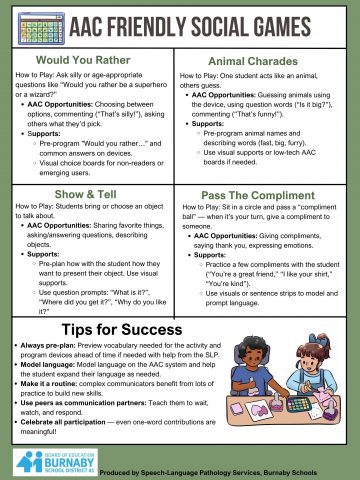
Classmates can be wonderful communication partners too! They can talk, play, wait for a response and pay attention to all the ways their classmate communicates.
One of the most important things we can do
For AAC learners, communication partners make an enormous difference. We can model AAC without pressure, give them time to respond, and notice communication even when it does not look the way we expect.
Every child has something to communicate. Our job is to notice, respond, and help give them more ways to share their thoughts, needs and ideas.






 Reload document
 Open in new tab